Tuesday, October 10, 2006

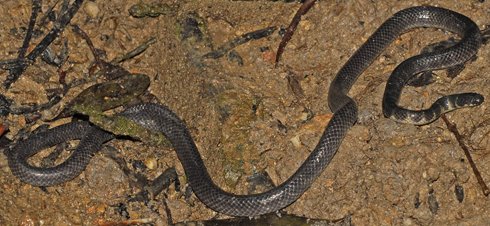
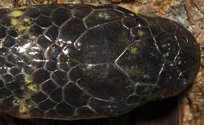
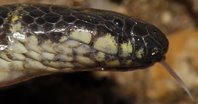
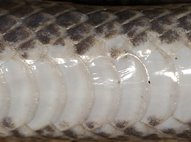
Banded Malayan Coral Snake (Calliophis intestinalis)

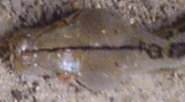
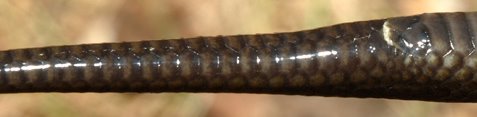
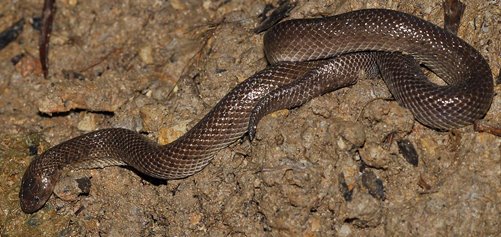
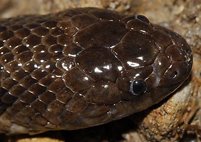
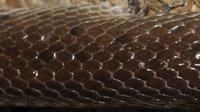
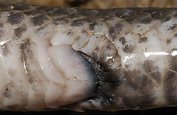
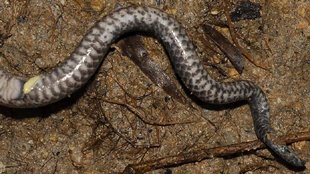
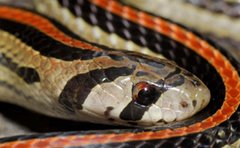
Debby Ng sent me this photograph of a Banded Malayan Coral Snake, Calliophis (Maticora) intestinalis, roadkill which she spotted just outside Mandai Track 15 on 23 Septempber 2006. This venomous but inoffensive snake is supposed to be fairly common but is seldom sighted, probably due to its burrowing and nocturnal nature (Lim & Lim, 1992).

REFERENCE

Lim, K. K. O. & Lim, F. L. K., 1992. A Guide To The Amphibians & Reptiles Of Singapore. SIngapore Science Centre, p. 89.

Tuesday, October 03, 2006

A Snakeful Night

Luck was with me on 29 September 2006.

Five snakes in a night!

There was a Common Malayan Racer (Coelognathus flavolineatus) that was faster than F1 racer, escaped before a photograph can be taken.


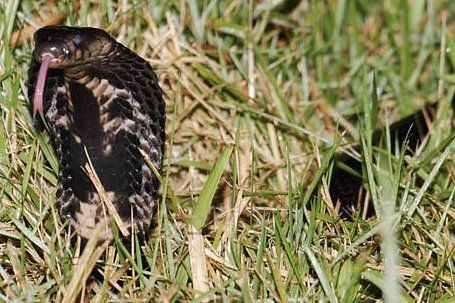
A Equatorial Spitting Cobra (Naja sumatrana) with cloudy eyes, suggesting that the snake is about to shed its skin.


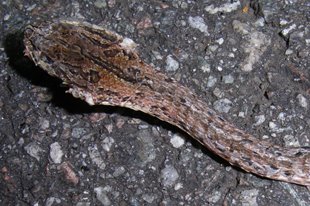
A Keel-bellied Whip Snake (Dryophiops rubescens) roadkill.


A juvenile King Cobra (Ophiophagus hannah) roadkill.


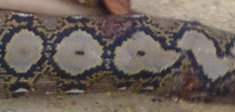
And finally ... the skeletal remains of a large Reticulated Python (Python reticulatus) in a monsoon drain.

Ok, I cheated a bit. But dead snakes are still snakes, and are important for locality recording purposes.

Sightings are from a northern offshore island of Singapore.

Previous sightings:

http://singaporesnakes.blogspot.com/2006/08/another-snake-roadkill.html
http://singaporesnakes.blogspot.com/2006/08/snake-roadkills-in-singapore_01.html

* All photographs from Mr Norman Lim and Mr Chim Chee Kong

Snake In A Park!

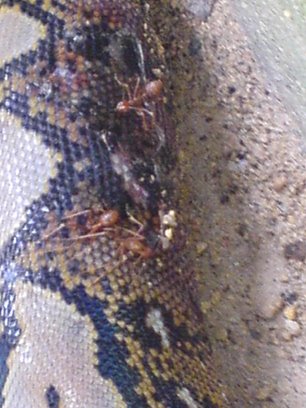
I was informed by Tay Ywee Chieh that a Reticulated Python (Python reticulatus) had attracted too much unwanted attention in Bishan Park after a hearty breakfast on 30 September 2006. The snake was too full for its own good, being too heavy to move to a less conspicuous spot to enjoy a lazy Saturday afternoon. People were threatening to call the AVA (Agri-Veteninary Authority) or other authorities to remove the python, a move which will most likely seal its fate. Ywee Chieh, with some knowledge on snakes, tried to convince the concerned crowd that the snake is a harmless one (which is true) and they should leave it alone. They left not entirely convinced. Apart from people, the snake was also terrorized by an army of ants which seemed to be "eating it alive". There was also high chance of the snake becoming a roadkill, since it was lying so near to the pavement. Being concerned about the safety of the poor creature, Ywee Chieh and a kind passerby commendably used a branch and moved the animal to a less eye-catching location.

WHAT TO DO IF I SAW A SNAKE IN A PARK?

The best thing to do is do nothing, unless you are 100% sure about the snake's identity. Thus, it is extremely important to know your snakes. This is to save the snake and you. More often than not, the snakes we killed are harmless ones. I believe that encounters such as the one mentioned above was not the fault of the python being a snake, but was the result of our ignorance. If we know more about our snakes, we can better handle a situation. A "snake-ledgeable" person is probably less likely to suffer heart attack when she/he encounters a legless friend.

Pythons longer than 3 m may be dangerous to man. If you are very sure that your existence is being threatened by snakes this big, call 999.


* All photographs by Ms Tay Ywee Chieh (using her mobile phone!)

Wednesday, September 27, 2006

Reptile skin smuggler jailed, fined.

Reptile skin smuggler jailed, fined
By Elena Chong
Saturday, September 23 2006.
The Straits Times, Home, H4.

An Indonesian seaman who smuggled in 11 bales of reptile skins last Thursday was sentenced to four months in jail and fined $10,000 yesterday.

Ali Mirhan, 24, a crew of the barge Sindora Seraya, pleaded guilty to importing 104 monitor lizard skins, six blood python skins and about 4,080 reticulated python skins from Indonesia without a permit.

He will serve an additional two months in jail as he was unable to pay the fine.

Agri-Food and Veterinary Authority (AVA) prosecuting officer Yap Teck Chuan said an Immigration and Checkpoints Authority (ICA) anti-smuggling team, acting on information, boarded the vessel at the Eastern Working Anchorage at about 4pm last Thursday.

They found 11 bales of skins worth about $250,000 hidden between canisters of fire extinguishers.

The reptiles are all protected under the Convention on International Trade in Endangered Species of Wild Fauna and Flora.

Ali said he was paid 100,000 rupiah (S$17) by an Indonesian-Chinese man in Selat Panjang to bring the reptile skins over. He was promised another $50 if the items were delivered successfully.

Singapore has often been labelled a centre for the illegal wildlife trade and criticised for being relax in enforcing laws.

"This is very damaging for Singapore, especially our international image, that we are a 'laundering' centre for illegal wildlife, particularly wildlife from biodiversity-rich neighbouring countries," said Mr Yap, who pressed for a deterrent sentence.

Parliament amended the law in March, increasing the maximum fine from $5,000 to maximum $500,000, and the maximum jail term doubled to two years.

Tuesday, August 29, 2006

"Curse" of "The Devil-Eyed"

A Shore Pit Viper (Trimeresurus purpureomaculatus) was sighted by Charlene Yeong in Lim Chu Kang mangroves on 28 August 2006, at about 9 pm. This venomous snake, as in my previous sightings in Pasir Ris Park Mangrove Swamp on 7 May 2006 and 18 August 2006, was lying on the ground coiling its body around mangrove roots and branch twigs. So please watch where you step and do not kill the snake under your feet! Oh, of course this is for your own safety too.

Somehow, I found a strange and unproven correlation between the presence of Short Pit Viper and the absence of crustacean-eating homalopsines (Cantoria violacea, Fordonia leucobalia and Gerarda prevostiana), and vice versa. This is the trend for all 6 nights:

4 September 2005 (Cantoria violacea)
7 May 2006 (Trimeresurus purpureomaculatus)
18 August 2006 (Trimeresurus purpureomaculatus)
19 August 2006 (Cantoria violacea and Fordonia leucobalia)
27 August 2006 (Fordonia leucobalia and Gerarda prevostiana)
28 August 2006 (Trimeresurus purpureomaculatus)

Could environmental factors be the cause of this observations?

Gerard's Water Snake (Gerarda prevostiana)

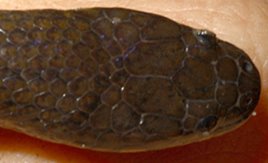
A Gerard's Water Snake (Gerarda prevostiana) was spotted by Helen Wong and caught by Lim Weiling in a tidal pool at the base of a mud lobster mound in Pasir Ris Park Mangrove Swamp on 27 August 2006, 9 pm. This mildly-venomous snake seems to be rather rare nowadays.

Karns et al., (2002) investigated on the homalopsine snakes population in Pasir Ris Park Mangrove Swamp, and found Gerarda prevostiana to be the second most common of four species in Pasir Ris Park, after the fish-eating Cerberus rynchops. Results showed that this species is more commonly encountered on full and new moon nights compared to half moon nights.

John Murphy and Harold Voris (2002) called Gerarda prevostiana "a snake with a secret".


They also wrote:
"Gerald's water snake remained a mystery in virtually all aspects of its biology until recently. Few museum specimens were available before the 1990's."

This trend holds true for the other crustacean-eating homalopsines found in Singapore: Cantor's Water Snake (Cantoria violacea) and Crab-eating Water Snake (Fordonia leucobalia).

Studies by a team of American biologists (Harold Voris, Daryl Karns and Bruce Jayne) here in 2001 shed invaluable light on these mysterious creatures.

It has been suggested that Gerard's water snake, like most homalopsines, feeds on fishes (Cox et al., 1998; Murphy & Voris, 2002; Voris & Murphy, 2002). Examination of museum specimens proved this to be wrong, and revealed that this snake preys on grapsid crabs (Murphy & Voris, 2002; Voris & Murphy, 2002).

In the laboratory, Bruce Jayne found that captive snakes feed only on freshly moulted crabs. The video can be downloaded here.

The table manners of Gerarda prevostiana is so unusual that it has never been documented in other snakes. All snakes are known to swallow food whole, except this species which uses a 'loop and pull' technique to tear its food into bite-sized pieces before enjoying the meal (Jayne et al., 2002; Murphy & Voris, 2002). By doing this, the snake can feed on prey that are otherwise too large for its mouth (gape). This is also probably the reason why Gerard's Water Snake loves soft-shelled crabs.

Like Fordonia leucobalia, the distribution of Gerarda prevostiana is remarkably similar to that of the mud lobster (Thalissina anomala) (Murphy & Voris, 2002). This snake hides in the burrows of mud lobster mounds, swims in tidal pools formed in depressions around the bases of mud lobster mounds, and moves in and out of the water and crab burrows on the outer surface of the mounds when foraging (Murphy & Voris, 2002; Voris & Murphy, 2002).

Gerarda prevostiana has been recorded from India, Sri Lanka, Thailand, Singapore and the Philippines (Murphy & Voris, 2002; Voris & Murphy, 2002). Locally, this snake has been collected from Pasir Ris Park and Lim Chu Kang (Karns et al., 2002; Voris & Murphy, 2002).


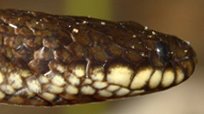
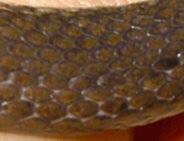
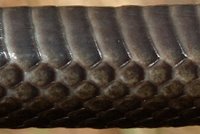
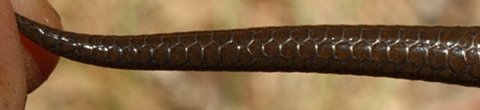
From left to right: Dorsal side of head; Ventral side of head; Right side of head; Dorsal side of body; Ventral side of body; Dorsal side of tail; Ventral side of tail.

* All photographs by Mr Lim Swee Cheng.

REFERENCES

Cox, M. J., van Dijk, P. P., Nabhitabhata, J. & Thirakhupt, K., 1998. A photographic guide to snakes and other reptiles of Peninsula Malaysia, Singapore and Thailand. New Holland Publishers (UK) Ltd, p. 42.

Jayne, B. C., Voris, H. K. & Ng, P. K. L., 2002. Snake circumvent constraints on prey size. Nature 418: 413.

Karns, D.R., Voris, H. K. & Goodwin, T. G., 2002. Ecology of Oriental-Australian rear-fanged water snakes (Colubridae: Homalpsinae) in the Pasir Ris Park Mangrove Forest, Singapore. The Raffles Bulletin of Zoology 50(2): 487-498.

Murphy, J. C. & Voris, H. K., 2002. Aquatic snakes with crustacean-eating habits elude herpetologists for two centuries. Litteratura Serpentium 22(3): 107-114.

Voris, H. K. & Murphy, J. C., 2002. The prey and predators of Homalopsine snakes. Journal of Natural History 36: 1621-1632.

INTERNET LINKS

http://www.fieldmuseum.org/museum_info/press/press_snake_eating.htm
http://whyfiles.org/shorties/109crab_snake/index.html
http://www.wildlifenews.co.uk/articles2002/july/july1302h.htm
http://animal.discovery.com/news/briefs/200207/snaketear.html

Wednesday, August 23, 2006

Bad Publicity For Snakes

Poor snakes.

New blow to their reputation.

And you thought they have enough bad publicity.

"Snakes On A Plane" (a ridiculousss Hollywood movie about snakes terrorising humans on a plane) will be opening tomorrow (24 August 2006) in Singapore theatres.


Before you become too paranoid after watching the show and decide to kill every snakes you encounter, it is important to know that only a small percentage of the almost 3,000 species of snakes in the world are dangerous to people.

I cannot get any figures from the books I have, but through googling, I found websites consistently stating the percentage to be 10%.

I think there are about 25 species of venomous snakes in Singapore, 11 of which are considered mildly venomous (venom which is often too mild to have any serious effects on normal humans), 7 of which inhabits the sea, some rarely bite people, and most are very shy/elusive.

In fact, ALL snakes (maybe except a huge and hungry Reticulated Python) cannot be bothered with humans, unless you "suay suay" disturbed them (e.g. stepped on their tails).

Interesting articles:
http://en.wikipedia.org/wiki/Snakebite
http://www.umass.edu/nrec/snake_pit/pages/myth.html

Video of Ular Laut in Pulau Hantu

Debby Ng of Hantu Bloggers has a wonderful video of a Yellow-lipped Sea Krait (Laticauda colubrina) swimming along the sea bed of Pulau Hantu.


Check out earlier SLOG post on this beautiful snake.

Crab-eating Water Snake (Fordonia leucobalia)

Two Crab-eating Water Snakes (Fordonia leucobalia) were sighted in Pasir Ris Park Mangrove Swamp on 19 August 2006, 9 pm. One snake was lying on the mudflat while the other was found on a mud lobster mound. My first encounter with this species was when I was part of a volunteering team "Snakehunters" led by a group of American biologists (Daryl Karns, Harold Voris & Bruce Jayne) researching on the ecology of homalopsines (A group of snakes that includes Fordonia leucobalia, Cantoria violacea, Gerarda prevostiana, and Cerberus rynchops) in Pasir Ris Park Mangrove Swamp in 2001. This study was published in our local biodiversity journal Raffles Bulletin of Zoology in 2002 [pdf, 1390 kb].

Ten years after the description of Fordonia leucobalia in 1837, Theodore Cantor recognized that F. leucobalia ate crabs, thus its common name (Murphy & Voris, 2002). Alan Savitzky (1983) suggested that this snake uses its jaws to crush crabs. John Murphy and Harold Voris (2002), however, found that the carapace always remained intact when F. leucobalia consumed hard-shelled crabs. Richard Shine and Terry Schwaner (1985) observed this species using an unusual form of constriction while feeding on crabs and removing and eating each of the crab's legs. By using the same method, F. leucobalia teared apart carapaces of very large soft shelled crabs (Murphy & Voris, 2002).

John Murphy and Harold Voris (2002) described the unique feeding strategy of Fordonia leucobalia:
"Small crabs were simply seized and swallowed with the strike, but larger crabs were handled in a different manner. The snake struck at the crab with a closed mouth, but instead of grabbing the crab in its jaws it slapped the crab with its chin. The crab, apparently realized it was under attack, withdrew its legs and sunk into the substrate into a defensive posture. The snake then went to work swallowing the crab sideways. Large crabs that resist predation may end up having the snake chewing on one of its legs, and as the crab tires, it may eject the leg to escape, leaving only a small piece of itself as a morsel for the snake."

This midly-venomous snake possesses massive fangs that look like nail punches built to puncture the hard chitinous exoskeleton of crabs (Murphy & Voris, 2002).

Cox et al. (1998) claimed that this species not only preys on crabs, but also on small fish.

Litters of 6-15 young, each 18 cm long, are known (Cox et al., 1998). Adults can grow up to 94 cm (Cox et al., 1998).

This nocturnal snake inhabits tidal rivers and coastal areas (Cox et al., 1998). It made extensive use of mud lobster mounds, has been observed foraging on mud tidal flats, and also known to use crab burrows (Karns et al., 2002).

It occurs from Burma through southern Thailand, Malaysia, Singapore and New Guinea to northern Australia, a distribution remarkably similar to mud lobsters (Thalissina anomala) (Barrett, 1950; Cox et al., 1998; Murphy & Voris, 2002).


From left to right: Dorsal side of head; Right side of head; Dorsal side of body; Ventral side of body; Ventral side of tail.

* All photographs by Chan Kwok Wai

REFERENCES

Barrett, C., 1950. Reptiles of Australia: crocodiles, snakes and lizards. Cassel & Company Limited, p. 113.

Cox, M. J., van Dijk, P. P., Nabhitabhata, J. & Thirakhupt, K., 1998. A photographic guide to snakes and other reptiles of Peninsula Malaysia, Singapore and Thailand. New Holland Publishers (UK) Ltd, p. 39.

Jayne, B. C., Voris, H. K. & Ng, P. K. L., 2002. Snake circumvent constraints on prey size. Nature 418: 413.

Murphy, J. C. & Voris, H. K., 2002. Aquatic snakes with crustacean-eating habits elude herpetologists for two centuries. Litteratura Serpentium 22(3): 107-114.

Savitzky, A. H., 1983. Coadapted character complexes among snakes: fossoriality, piscivory, and durophagy. American Zoologist 23: 397-409.

Shine, R. & Schwaner, T., 1985. Prey constriction by venomous snakes: a review and new data on Australian species. Copeia 1985(4): 1067-1071.

Sunday, August 20, 2006

Cantor Lost It's Golden Rings


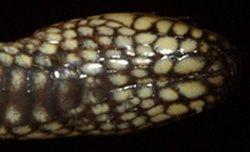
Joe Ong spotted a Cantor's Water Snake (Cantoria violacea) on the mudflat in Pasir Ris Park Mangrove Swamp on 19 August 2006, 10pm. The scale pattern of this individual is slightly different from that of the other snake I found on 4 December 2005. The golden rings of the former are not present throughout the whole body and tail as in the latter. Chan Kwok Wai captured wonderful close-up shots of this beautiful snake.


From left to right: Dorsal side of head; Right side of head, Dorsal side of body, Ventral side of body; Cloaca; Ventral side of tail.

* All photographs by Mr Chan Kwok Wai.