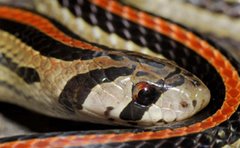
A Gerard's Water Snake (Gerarda prevostiana) was spotted by Helen Wong and caught by Lim Weiling in a tidal pool at the base of a mud lobster mound in Pasir Ris Park Mangrove Swamp on 27 August 2006, 9 pm. This mildly-venomous snake seems to be rather rare nowadays.
Karns et al., (2002) investigated on the homalopsine snakes population in Pasir Ris Park Mangrove Swamp, and found Gerarda prevostiana to be the second most common of four species in Pasir Ris Park, after the fish-eating Cerberus rynchops. Results showed that this species is more commonly encountered on full and new moon nights compared to half moon nights.
John Murphy and Harold Voris (2002) called Gerarda prevostiana "a snake with a secret".
They also wrote:
"Gerald's water snake remained a mystery in virtually all aspects of its biology until recently. Few museum specimens were available before the 1990's."
This trend holds true for the other crustacean-eating homalopsines found in Singapore: Cantor's Water Snake (Cantoria violacea) and Crab-eating Water Snake (Fordonia leucobalia).
Studies by a team of American biologists (Harold Voris, Daryl Karns and Bruce Jayne) here in 2001 shed invaluable light on these mysterious creatures.
It has been suggested that Gerard's water snake, like most homalopsines, feeds on fishes (Cox et al., 1998; Murphy & Voris, 2002; Voris & Murphy, 2002). Examination of museum specimens proved this to be wrong, and revealed that this snake preys on grapsid crabs (Murphy & Voris, 2002; Voris & Murphy, 2002).
In the laboratory, Bruce Jayne found that captive snakes feed only on freshly moulted crabs. The video can be downloaded here.
The table manners of Gerarda prevostiana is so unusual that it has never been documented in other snakes. All snakes are known to swallow food whole, except this species which uses a 'loop and pull' technique to tear its food into bite-sized pieces before enjoying the meal (Jayne et al., 2002; Murphy & Voris, 2002). By doing this, the snake can feed on prey that are otherwise too large for its mouth (gape). This is also probably the reason why Gerard's Water Snake loves soft-shelled crabs.
Like Fordonia leucobalia, the distribution of Gerarda prevostiana is remarkably similar to that of the mud lobster (Thalissina anomala) (Murphy & Voris, 2002). This snake hides in the burrows of mud lobster mounds, swims in tidal pools formed in depressions around the bases of mud lobster mounds, and moves in and out of the water and crab burrows on the outer surface of the mounds when foraging (Murphy & Voris, 2002; Voris & Murphy, 2002).
Gerarda prevostiana has been recorded from India, Sri Lanka, Thailand, Singapore and the Philippines (Murphy & Voris, 2002; Voris & Murphy, 2002). Locally, this snake has been collected from Pasir Ris Park and Lim Chu Kang (Karns et al., 2002; Voris & Murphy, 2002).
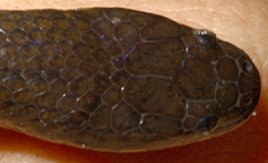
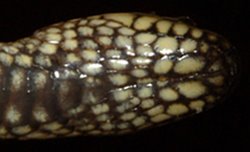
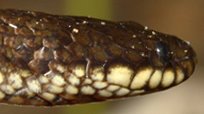
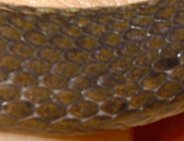
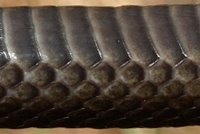
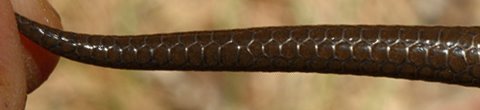
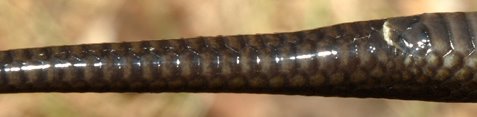
From left to right: Dorsal side of head; Ventral side of head; Right side of head; Dorsal side of body; Ventral side of body; Dorsal side of tail; Ventral side of tail.
* All photographs by Mr Lim Swee Cheng.
* All photographs by Mr Lim Swee Cheng.
REFERENCES
Cox, M. J., van Dijk, P. P., Nabhitabhata, J. & Thirakhupt, K., 1998. A photographic guide to snakes and other reptiles of Peninsula Malaysia, Singapore and Thailand. New Holland Publishers (UK) Ltd, p. 42.
Jayne, B. C., Voris, H. K. & Ng, P. K. L., 2002. Snake circumvent constraints on prey size. Nature 418: 413.
Karns, D.R., Voris, H. K. & Goodwin, T. G., 2002. Ecology of Oriental-Australian rear-fanged water snakes (Colubridae: Homalpsinae) in the Pasir Ris Park Mangrove Forest, Singapore. The Raffles Bulletin of Zoology 50(2): 487-498.
Murphy, J. C. & Voris, H. K., 2002. Aquatic snakes with crustacean-eating habits elude herpetologists for two centuries. Litteratura Serpentium 22(3): 107-114.
Voris, H. K. & Murphy, J. C., 2002. The prey and predators of Homalopsine snakes. Journal of Natural History 36: 1621-1632.
INTERNET LINKS
http://www.fieldmuseum.org/museum_info/press/press_snake_eating.htm
http://whyfiles.org/shorties/109crab_snake/index.html
http://www.wildlifenews.co.uk/articles2002/july/july1302h.htm
http://animal.discovery.com/news/briefs/200207/snaketear.html