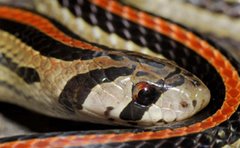
The Striped Kukri Snake (Oligodon octolineatus), as in all kukri snakes, possesses remarkably sharp teeth in the shape of kukri knives that probably allow it to cut open bird eggs, which form a large part of its natural diet (Lim & Lee, 1989; Lim & Lim, 1992). This nocturnal snake also feeds on frogs, lizards, other snakes, and frog spawn (Lim & Lee, 1989; Lim & Lim, 1992).
This handsome snake can grow up to a total length of 60 cm (Lim & Lee, 1989; Lim & Lim, 1992). It is non-venomous and is generally inoffensive (Lim & Lee, 1989; Lim & Lim, 1992). However, if it is provoked, it has a habit of hiding its head under its coil and raising and waving its tail to reveal the coral pink undersides (Lim & Lee, 1989). It also discharges a foul smell (Lim & Lee, 1989).
Breeding seems to occur all year round for this oviparous snake, which can lay up to five eggs in a clutch (Lim & Lee, 1989; Lim & Lim, 1992). In the wild, eggs are often deposited in soil, and in piles of vegetation debris and sawdust (Lim & Lee, 1989).
Oligodon octolineatus is considered a terrestrial-burrowing snake (Lim & Lim, 1992) and is fairly common in gardens, cultivated areas and forests in Singapore (Lim & Lee, 1989; Lim & Lim, 1992).

This is a roadkill photographed by Chan Kwok Wai in Choa Chu Kang on 1 July 2007.

This handsome snake was photographed by Norman Lim along Chestnut Avenue on 28 March 2006 at about 10 pm. Note the tail coiling displayed by the snake when provoked.

This snake was photographed by Wong Yueat Tin in Chinese Garden on 6 April 2006 at about 9 pm. It was initially on a pavement.
REFERENCES
Lim, F. L. K. & Lee, M. T. M., 1989. Fascinating Snakes of Southeast Asia – an Introduction. Tropical Press, Kuala Lumpur, p. 46-47.
Lim, K. K. P. & Lim, F. L. K., 1992. A Guide To The Amphibians & Reptiles Of Singapore. Singapore Science Centre, p. 59.