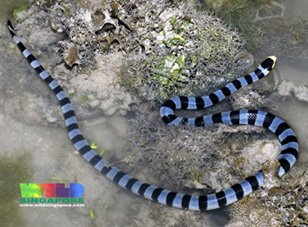
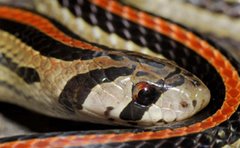
This Banded Krait (Bungarus fasciatus), photographed by Loh Kok Sheng and posted in his blog, made a pleasantly surprised appearance at the launch of the Chek Jawa Wetlands on the morning of 7 July 2007.
Norman Lim encountered this snake last year, also along a muddy shore, but on another northern island of Singapore. This 'common occurence' of banded kraits in aquatic habitats are unusual because these are known to be terrestrial snakes. Maybe we just do not know much about them.
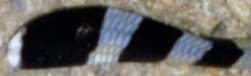
It is common that people misidentified the Banded Krait as the Yellow-lipped Sea Krait (pictured above). Both species belong to the same family of Elapidae (a group of venomous snakes including cobras, old-world coral snakes and true sea snakes). However, kraits belong to the genus Bungarus while sea kraits belong to the genus Laticauda. Although both snakes have the black-and-white bands along their body, the Banded Krait lacks the paddle-shaped tail tip that its cousin Yellow-lipped Sea Krait possesses. This tail shape allows the sea krait to swim more efficiently in the open sea.
Tails of Banded Krait (above) and Yellow-lipped Sea Krait (below).
Yellow-lipped Sea Kraits (Laticauda colubrina) are large (to 1.5 m, 2 kg) amphibious sea snakes that forage for eels in tropical oceans but return to land to digest their prey, slough their skins, mate, and lay eggs (Lim & Lee, 1989; Lim & Lim, 1992; Cox et al., 1998; Shetty & Shine, 2002a). This species is usually found on coral atolls and rocky islets where it congregates in large numbers during the breeding season (Lim & Lee, 1989; Lim & Lim, 1992; Cox et al., 1998). The loss of such habitats in Singapore is threatening this beautiful snakes (Ng, 1995). The eggs are laid in clutches of 5-9 (Cox et al., 1998), and deposited in crevices and holes in the rocks (Lim & Lee, 1989). The hatching of the eggs was reported to occur in the period of June to August on islands near Singapore (Lim & Lee, 1989; Cox et al., 1998). This snake is widely distributed, ranging from the Bay of Bengal to the southwestern part of the Pacific Ocean (Lim & Lee, 1989; Cox et al., 1998).
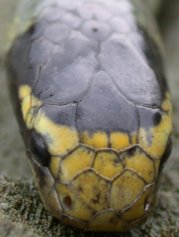
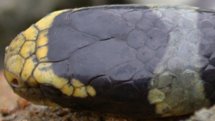
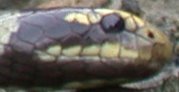
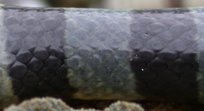
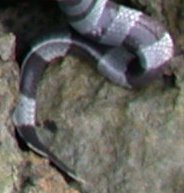
From left to right: Dorsal side of head; Left side of head; Right side of head; Dorsal side of body; Right side of body; Ventral side of body; Dorsal side of tail, Right side of tail. My first encounter with a Yellow-lipped Sea Krait (Laticauda colubrina) was on 24 June 2005 at about 10 am. The snake was on the water’s surface near the jetty of St. John’s Island. It was behaving strangely, somewhat twisting and turning. I recorded three video clips:
I noticed that there is a bulge at the region of the snake's stomach (indicating that it just had a meal?). It soon “floated” very near to the seawall. I wanted to check if the snake was suffering from any injuries or diseases, so I picked it up and rested it on the sea wall. The snake looked “normal”. It disappeared into the deep waters after being released.
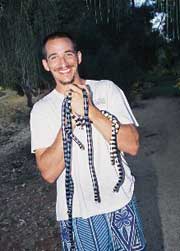
These highly venomous snakes are generally non-aggresive but they might bite when roughly handled (Chou, 1993). Reptile ecologist Robert Reed, pictured on the left, even commented that "The Yellow-lipped Sea Krait is so tame and docile that the venomous animals can be collected by the handful".
Ria Tan (Wild Singapore) and Debby Ng (Hantu Bloggers) have also sighted Yellow-lipped Sea Kraits in the Southern Islands. These are their accounts:
The ecology and behaviour of Yellow-lipped Sea Kraits are relatively little known until recently when researches conducted by Sohan Shetty and Richard Shine on the Fijian islands produced a wealth of knowledge on these beautiful creatures. Below is a summary of their findings:
Yellow-lipped sea kraits spent equal amounts of time on land versus in the ocean, moving between these two habitats about once every 10 days (Shetty & Shine, 2002a). These snakes maintained relatively high and constant body temperatures both while on land and in the water; the only overt thermoregulation involved shade-seeking (Shetty & Shine, 2002a). Juvenile sea kraits rarely ventured far from water, whereas adults often moved well inland (Shetty & Shine, 2002a). The snakes move about at night, engaged in courtship during the morning and were inactive during the afternoon (Shetty & Shine, 2002a). Thus, snakes were frequently found in courting groups during the morning, but most were solitary at night (Shetty & Shine, 2002a). Male sea kraits move about more frequently and actively on land than do females (Shetty & Shine, 2002a).
The mating season is from September to December (Shetty & Shine, 2002d). On land, many females are accompanied by one or more courting males (Shetty & Shine, 2002d). The males align their bodies with that of the female and occasionally twitch spasmodically (Shetty & Shine, 2002d). These groups remain together for days, with overt courtship by males much less frequent and intense than in most previously-studied snake species (Shetty & Shine, 2002d). Larger females attracted more intense courtship than did smaller animals (Shetty & Shine, 2002d).
Females grow much larger than males, and have longer and wider heads than do conspecific males of the same body length (Shetty & Shine, 2002c). Adult female sea kraits feed primarily on larger conger eels, and take only a single prey item per foraging bout (Shetty & Shine, 2002c). In contrast, adult males feed upon smaller moray eels, and frequently take multiple prey items (Shetty & Shine, 2002c). Prey size increases with snake body size in both males and females (Shetty & Shine, 2002c). Female sea kraits consume larger eels relative to predator head size and body length than do males (Shetty & Shine, 2002c).
Males have much longer tails (relative to snout-vent length) than do females (Shine & Shetty, 2001b). This sex difference may reflect the fact that females use their tails primarily for swimming, whereas males also must frequently use the tail in terrestrial locomotion and in courtship as well as for swimming (Shine & Shetty, 2001b).
The evolutionary modifications of these snakes for marine life have enhanced their swimming speeds by about 60%, but decreased their terrestrial locomotor speed by about 80% (Shine & Shetty, 2001a). Larger snakes moved faster than smaller individuals in absolute terms but were slower in terms of body lengths travelled per second, especially on land (Shine & Shetty, 2001a). Male sea kraits were faster than females (independent of the body-size effect), especially on land (Shine & Shetty, 2001a). Prey items in the gut reduced locomotor speeds both on land and in water (Shine & Shetty, 2001a).
Shetty and Shine (2003) also found that relocated snakes returned “home” almost immediately after they were released.
REFERENCES
Chou, L. M., 1993. A Guide To The Dangerous Marine Animals Of Singapore. Singapore Science Centre, p. 160.
Cox, M. J., van Dijk, P. P., Nabhitabhata, J. & Thirakhupt, K., 1998. A photographic guide to snakes and other reptiles of Peninsula Malaysia, Singapore and Thailand. New Holland Publishers (UK) Ltd, p. 12.
Lim, F. L. K. & Lee, M. T. M., 1989. Fascinating Snakes of Southeast Asia – an Introduction. Tropical Press, Kuala Lumpur, p. 30.
Lim, K. K. P. & Lim, F. L. K., 1992. A Guide To The Amphibians & Reptiles Of Singapore. Singapore Science Centre, p. 147.
Ng, P. K. L., 1995. A Guide To The Threatened Animals Of Singapore. Singapore Science Centre, p. 160.
Shetty, S. & Shine, R., 2002. Activity patterns of yellow-lipped sea kraits (Laticauda colubrina) on a Fijian island. Copeia 2002: 77-85.
Shetty, S. & Shine, R., 2002. Philopatry and homing behavior of sea snakes (Laticauda colubrina) from two adjacent islands in Fiji. Conservation Biology 16: 1422-1426.
Shetty, S. & Shine, R., 2002. Sexual divergence in diets and morphology in Fijian sea snakes, Laticauda colubrina (Laticaudidae). Austral Ecology 27: 77-84.
Shetty, S. & Shine, R., 2002. The mating system of yellow-lipped sea kraits (Laticauda colubrina, Laticaudinae). Herpetologica 58: 170-180.
Shine, R., & Shetty, S., 2001. Moving in two worlds: aquatic and terrestrial locomotion in sea snakes (Laticauda colubrina, Laticaudidae). Journal of Evolutionary Biology 14: 338-346.
Shine, R., & Shetty, S., 2001. The influence of natural selection and sexual selection on the tails of sea-snakes (Laticauda colubrina). Biological Journal of the Linnean Society 74: 121-129.