Friday, August 18, 2006

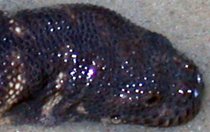
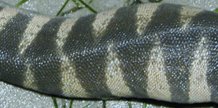
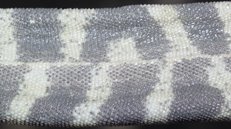
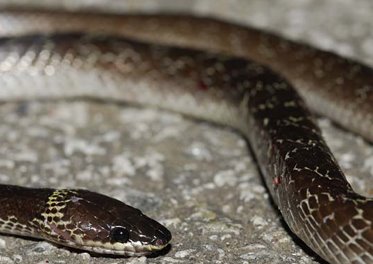
Banded File Snake (Acrochordus granulatus)

Ria Tan seems to have lots of luck with Banded File Snakes (Acrochordus granulatus), having sighted them 3 times on the northern shores of Singapore:

Chek Jawa 21 October 2001
Chek Jawa 16 June 2003
Pulau Sekudu 10 July 2005

This nocturnal species inhabits various coastal habitats such as shallow seas, river mouths, estuaries and mangroves (Lim & Lee, 1989; Lim & Lim, 1992; Cox et al., 1998). It feeds on fishes, including eels (Lim & Lee, 1989; Lim & Lim, 1992; Cox et al., 1998).

These live-bearers produce a litter of 5-10 young, averaging 22 cm, after about six months' gestation (Cox et al., 1998). One individual was found to have 7 fully developed embryos in late April (Lim & Lee, 1989). This non-venomous species can grow to about 1 m in length (Lim & Lee, 1989; Lim & Lim, 1992; Cox et al., 1998).

It ranges from India to northern Australia and to Hainan (Cox et al., 1998).
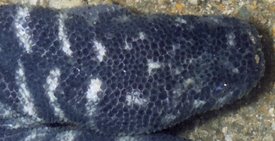


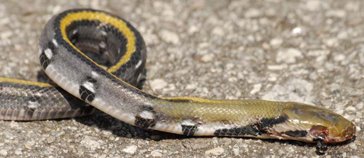
From left to right: Dorsal side of head; Right side of head; Dorsal side of body; Ventral side of body; Dorsal side of tail.


* All photographs by Ms Ria Tan.

References

Cox, M. J., van Dijk, P. P., Nabhitabhata, J. & Thirakhupt, K., 1998. A photographic guide to snakes and other reptiles of Peninsula Malaysia, Singapore and Thailand. New Holland Publishers (UK) Ltd, p. 12.

Lim, F. L. K. & Lee, M. T. M., 1989. Fascinating Snakes of Southeast Asia – an Introduction. Tropical Press, Kuala Lumpur, p. 30.

Lim, K. K. P. & Lim, F. L. K., 1992. A Guide To The Amphibians & Reptiles Of Singapore. Singapore Science Centre, p. 147.

Thursday, August 17, 2006

What's Hisss Name?

Since we live in a multi-lingual society, I supposed it is useful to know the name of our beloved limbless friends in all five "National" languages:

English: Snake
Malay: Ular
Mandarin: She (pronounce "Sir")
Singlish (Hokkien in this case): Zua
Tamil: Pambu

Another Snake Roadkill

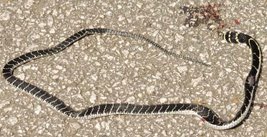
Another roadkill sighted by Norman Lim on The Singapore Offshore Island. This House Wolf Snake (Lycodon capucinus) was found lying on the side of the road on 10 August 2006. It was not flattened but has some scratches. Perhaps it was abandoned after being attacked by a predator (e.g. bird)? Nobody knows.

SLOG had already documented 6 other snake species from this locality, most of which are thanks (oh well ...) to roadkills:

Keel-bellied Whip Snake (Dryophiops rubescens) 20 May 2006
Banded Krait (Bungarus fasciatus) 21 May 2006
Common Malayan Racer (Coelognathus flavolineatus)27 June 2006
Painted Bronzeback (Dendrelaphis pictus)27 June 2006
Equatorial Spitting Cobra (Naja sumatrana) 27 June 2006
King Cobra (Ophiophagus hannah) 27 June 2006

I am sure there are many more out there ...

Wednesday, August 09, 2006

"Gor Yok" Uncle and His Gold-ringed Cat Snake

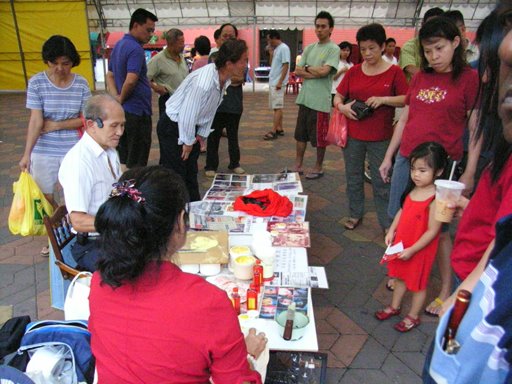
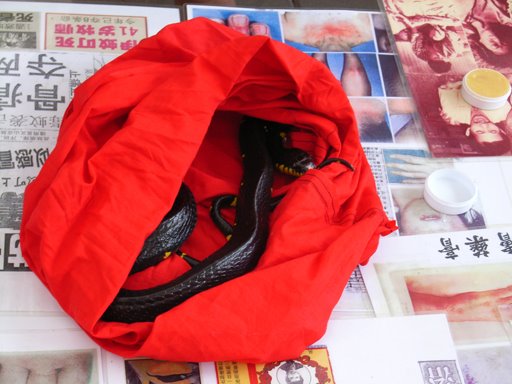
I chanced upon this uncle selling "gor yok" (膏药; medical oilment) in Jurong West today. On the table is this Gold-ringed Cat Snake (Boiga dendrophila) displayed in an opened red bag. I am not sure what the legless friend has got to do with the medicine the uncle is selling but it is definitely a crowd-puller!

People might have mistaken the snake for a highly venomous snake such as a cobra or a krait, and somehow formed an equation of "uncle not afraid of venomous snake" = "medicine is good" = "must buy!" Haha.

Monday, August 07, 2006

Blind snake MTV


Blind snake 1
Release from box, back to home sweet soil
4th July 06, approx. 5pm, Junyuan Primary School


Blind snake 2
Found another one 5m away! woo hoo!
4th July 06, approx. 5.30pm, Junyuan Primary School


Stalking Blindy who was so camera shy. Not sure if it's the same guy as the lucky one spotted on 4th July.
7th July 06, approx. 5pm, Junyuan Primary School


The secret location of where Blindy 2 stakes out - under the stone slab!
7th July 06, approx. 5.30pm, Junyuan Primary School
*Thanks to my very enthusiastic P6 Science Gym students who tirelessly lift up almost all the stone slabs in their ecogarden!

Wednesday, August 02, 2006

There used to be a lot of snakes in Singapore

I chanced upon this extremely illogical but hissslarious article by T. S. Daniel (19 May 2004, Singapore Can!), when I was googling on "Singapore Snakes".

There used to be a lot of snakes in Singapore

"There are not very many snakes slithering around the streets of Singapore, But there are a few. And they are very big. Usually about 30 metres long. It wasn’t always like this. Snakes used to be much smaller and there were thousands of them everywhere. What happened is that the stronger snakes started to eat the weaker snakes. This usually meant that the longer snakes were swallowing the shorter snakes. To cut a long story short, the reason there aren’t many snakes left and why those that are left are so big is because they have swallowed all the others. It has been calculated that within 5 years there will be only one snake left in Singapore. And that snake will be so big that when he gets hungry he will mistake the end of his tail for another snake and start eating it. This won’t hurt, of course, because his other end will be so far away. And snake pain doesn’t travel very fast. This, the mad hotness of the sun beating down and the lack of water will probably mean that he will gobble himself up in no time. Then there will be no snakes at all. This is what happened in Ireland."

A Snake-Charmed Life in Singapore

Michael Richardson wrote the article "A Snake-Charmed Life in Singapore" in International Herald Tribute on 07 Jan 1997.

The article might be old, but I think it is still good enough to share with you. N. Sivasothi of Habitatnews has kindly uploaded a pdf file of the article on his website.

Richardson was charmed by the snakes in Singapore. I am charmed by him, especially his change of perspective towards snakes.

Some interesting extracts from the article:

" As a boy who spent time on farms in Australia, I was taught that the best snake is a dead one."

" So when I arrived in Singapore — a small island-state where nearly all of the original tropical. jungle has been replaced by apartment and office blocks, factories, highways and manicured parks and gardens — I did not expect any further problems with snakes."

"I have lately discovered that one of the reasons Singaporeans are disinclined to rent such places (old British military quarters) — apart from their reputation as being haunted — is the prevalence of snakes."

" But it is hard to feel so affectionate about the snakes that seek sanctuary in the park where we live."

" I never try to harm these snakes as none of them is aggressive or seriously venomous."

"The snake was fully exposed on a bare embankment — a relatively easy target for my stick. But instead of striking, I hesitated, mesmerized by its slow, sinuous movement."
.
"It was true that I was still recovering from food poisoning. But that was only part of the truth."

Tuesday, August 01, 2006

Snake Roadkills in Singapore

Norman Lim sighted FOUR roadkills of different snake species on a single day (27 June 2006) on an offshore island of Singapore: Coelognathus flavolineatus (Common Malayan Racer), Dendrelaphis pictus (Painted Bronzeback), Naja sumatrana (Equatorial Spitting Cobra), and a Ophiophagus hannah (King Cobra) juvenile.

Snakes need to bask but these poor souls were probably enjoying a nice sun tan, when they were driven to their graves. Nobody knows how many snakes are killed this way in Singapore. Please drive safely, for the snakes.

Bad for snakes but good for scientists. Live snakes are hard to collect, thus dead specimens are extremely precious. Scientists can still collect loads of useful data from well-preserved specimens, without killing one. You can do your part for local conservation by reporting roadkills to the Raffles Museum of Biodiversity Research soon after your sighting.

Sunday, July 02, 2006

Malayan Brown Snake Xenelaphis hexagonotus


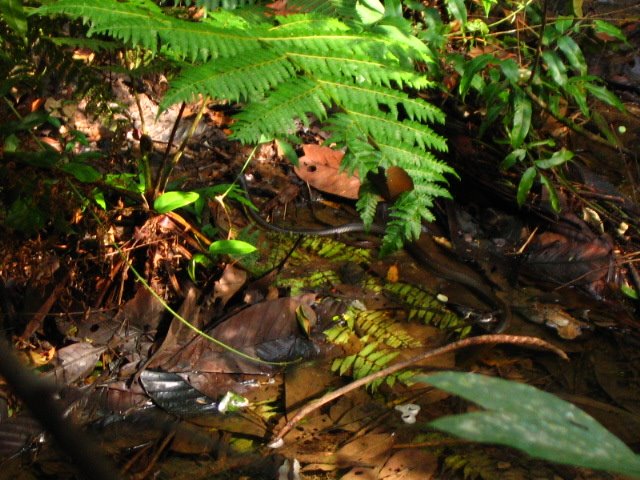
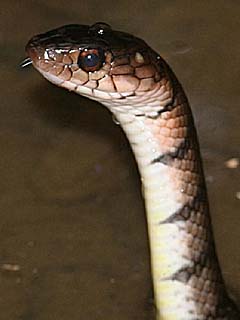
An unexpected sighting of this long snake while on a fieldtrip to CCNR one day...well ok spotted on 22nd June 06 10.15 plus minus 15min in the morning if you have to know. Noone will blame you if you can't really see the brown snake in the midst of the brown background, it's the best shot ive got! In any case, this guy was busy swimming up & down the forest stream, foraging or perhaps it got agitated by some humanoid screams. I hope it didn't become deaf! After some verification with Mr Snake Hunter* himself, this creature is most probably a Malayan Brown Snake, Xenelaphis hexagonotus. For those fact hungry people, do read on...

Upclose: Beautifully captured by Norman Lim and K W Chan
(see Wildlife Singapore)


Reaching around 2 metres in length, the Malayan Brown Snake is a harmless, largely terrestrial species inhabiting forests, plantations and swamps (freshwater and mangrove).
It feeds on other vertebrates, particularly rodents, but in freshwater swamp habitats it is known to be highly aquatic in behaviour, feeding chiefly on small fishes and frogs. The typical hunting method is to adopt an erect posture, waiting for prey to come into range, and then to strike quickly.

Dorsal scales are brown, becoming more olive-green posteriorly, especially in juveniles. A regular series of dark brown bands extends slightly onto the belly, which is white or pale yellow.
The species ranges from Southern Burma and Southern Thailand, and parts of Indochina, through Peninsular Malaysia and Singapore to the Riau Archipelago, Sumatra, Borneo and Java.

Info adapted from Nick Baker's EcologyAsia, click on this to check out his snapshots.

Another lucky candidate mphil spotted a Malayan Brown on P. Ubin, his posting on ClubSnap). According to him & Nparks,
this species has yet to make it to the NParks list of snakes found on P.Ubin. Well now we know these guys are around in our backyard, aint that comforting =o>

*Chim C K